ReLAB: Reconditioning of Decommissioned Lead Acid Batteries for use as Low-Cost Energy Storage Solution
Use Cases
Circular Manufacturing Systems Program
The Circular Manufacturing Systems Programme (CMSP) is part of the Twente Regio Deal and is funded by the Province of Overijssel and the Ministry of Economic Affairs and Climate Policy (EZK). Managed by the Fraunhofer Innovation Platform at the University of Twente (FIP-AM@UT), the programme brings together industry partners to advance sustainable, data-driven, and circular manufacturing solutions across the full battery lifecycle.
The use cases below show how CMSP accelerates innovation in design, diagnostics, production, repurposing, and disassembly, which leads to measurable improvements in resource efficiency, emissions reduction, and regional capability building.
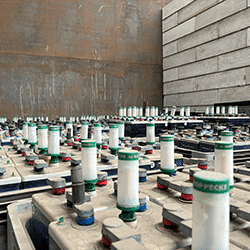
Given the environmental impact and resource waste associated with discarded lead-acid batteries, sustainable solutions for repurposing them are critically needed. This project tackles the challenge by assessing battery health, optimizing refurbishment techniques, and developing a practical framework to extend lifespan and enable cost-effective reuse. By identifying suitable applications within Riwald’s operations and local energy storage systems, it delivers a scalable reconditioning process with clear viability metrics, supporting affordable and sustainable second-life use of lead-acid batteries across industrial and community energy needs.
The project directly supports UN Sustainable Development Goal 7: Affordable and Clean Energy and Goal 9: Industry, Innovation, and Infrastructure. It contributes to affordable, reliable energy through battery reconditioning and strengthens infrastructure to enhance sustainability, energy efficiency, and product lifespan.
Industry Partner

BattInnovate: Innovative Development and Circular Optimisation of Battery Technologies for Sustainability

The electric motorbike industry faces challenges in boosting battery performance, efficiency, and sustainability due to limited energy transfer, durability, and reuse potential. This project addresses these issues by optimizing energy transfer, enhancing battery durability, and validating scalable assembly processes. It also explores sustainable strategies for repurposing battery modules to extend their lifecycle. Key outcomes include optimised cell-to-collector connections, high-performance cells, a validated pilot-scale assembly process, and effective module repurposing methods that improve efficiency and reduce environmental impact across battery applications.
The project directly supports UN Sustainable Development Goal 7: Affordable and Clean Energy by advancing battery module technology to improve energy storage systems.
Industry Partner

ExtraCycles: Tools and methods for circular battery lifecycle
The battery industry faces major sustainability challenges due to production errors, limited maintenance, and complex disassembly. This project promotes circular manufacturing by reducing waste, extending battery life, and enabling reuse. Focusing on production, maintenance, and disassembly, it applies eco-design to prevent errors, develops testing tools for improved maintenance, and creates solutions that support battery reuse. A key outcome is the development of digital and conceptual tools that enhance battery assembly, testing, and reuse, driving efficiency and sustainability across the entire battery lifecycle.
The project directly supports UN Sustainable Development Goal 12, which focuses on ensuring sustainable consumption and production patterns by reducing waste generation through prevention, reduction, recycling, and reuse in battery production, use, and disassembly.
Industry Partner

ElectroCycle: Design to Maximise the Performance

The electric motorbike industry faces challenges in improving performance and sustainability due to heavy components, non-renewable materials, and inefficient battery connectivity. This project tackles these issues by redesigning key parts to reduce weight, integrate sustainable materials, and enhance battery efficiency. It develops a lightweight swingarm using topology optimization and 3D printing, a flax-fibre tank cover, and an improved battery connection system. These innovations reduce material use, increase energy efficiency, and enhance overall performance through sustainable component design.
The project directly supports UN Sustainable Development Goal 12 by reducing raw material consumption through lightweighting and the use of nature-based materials. It also contributes to Goal 13 by lowering emissions through improved electrical performance of the motorbike.
Industry Partner

MoCoSo: Modular Control Software for Reuse of Assembly Equipment

Reusing industrial equipment supports a circular economy by extending its lifespan, reducing waste, and lowering emissions from new production. Project MoCoSo aims to make repurposing automated machinery more cost-effective by developing flexible hardware and adaptable, modular software architecture. Using a battery welding machine equipped with an ABB robot and Beckhoff’s XPlanar system as a test case, the project creates reusable software modules that improve maintainability, reduce waste, and enhance economic efficiency. A key outcome is modular machine control software that integrates real-time and organisational components.
The project directly supports UN Sustainable Development Goal 12 by promoting economic growth while reducing environmental impact through recycling and waste reduction.
Industry Partner

DigitalSpine: A data intelligence platform for battery line
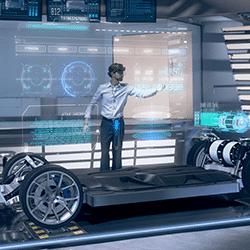
Battery manufacturing is limited by fragmented data systems that hinder efficiency, communication, and the integration of smart production across factory layers. This project addresses these challenges by developing a unified data platform that connects systems and supports circular lifecycle management. By integrating diverse data sources using open standards, it delivers structured, real-time insights through visual dashboards and prepares information for AI-driven decision-making. Key outcomes include improved production visibility, reduced waste, better-informed decisions, and alignment with AI readiness and future EU battery passport requirements.
The project directly supports UN Sustainable Development Goal 9 by implementing an integrated digital infrastructure that strengthens industrial innovation. It also contributes to Goal 12 by enabling circular production and reducing waste through optimized battery assembly and disassembly.
Industry Partner

CyclePCBA: Early Defect Detection For Minimizing Scrap and Enhancing Reusability in PCBA Production

High-mix, low-volume PCBA production often faces challenges with late defect detection, leading to high scrap rates and limited component reuse. This project addresses these issues by enabling early identification of PCBA defects through image-based analysis. Feature extraction techniques reveal component-level characteristics linked to common failure types, while AI-driven algorithms classify defects and validate proof-of-concept cases. Key outcomes include a prototype inspection system, an initial component database, a digital development roadmap, and improved production sustainability through reduced waste and greater reuse potential.
The project directly supports UN Sustainable Development Goal 8 by enhancing economic productivity with AI-assisted inspection systems and driving innovation in labour-intensive sectors. It also supports Goal 9 by developing digital infrastructure for early defect detection, boosting production efficiency and industrial innovation. Additionally, it contributes to Goal 12 by reducing waste and improving component reusability, promoting more sustainable consumption and production practices.
Industry Partner

FoilsMatInsight: Material behaviour investigation for improved aluminium packaging performance
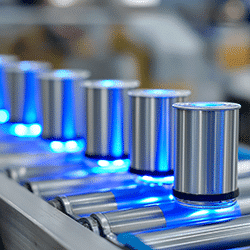
The packaging industry faces increasing pressure to reduce material use while maintaining high reliability, particularly in pharmaceutical applications. While downgauging aluminium foils improves sustainability and lowers costs, it also introduces variability risks that can affect packaging integrity. Project FoilsMatInsight addresses this challenge by analysing material-driven variability in 160 µm tray foils through targeted material assessment and simulation. The project identifies key factors influencing variability and provides recommendations that improve consistency, strengthen process control, and enhance overall packaging performance.
The project directly supports UN Sustainable Development Goal 12 by promoting responsible production, reducing material waste, and improving resource efficiency. It also contributes to Goal 9 by advancing sustainable industrial practices and innovation, and to Goal 17 by fostering cross-sector collaboration that strengthens long-term environmental and supply-chain sustainability.
Industry Partner

DCC Bess: Lightweight Circular Composites for Unmanned Cargo Aircraft Structures

As industry moves toward advanced DC energy systems, designing safe multi-source, multi-load DC grids without galvanic insulation remains a major challenge due to strict safety, grounding, and regulatory requirements. Building on earlier VDL work, this project develops a reliable DC-bus connection for non-isolated grids. It reviews standards, assesses protection and grounding needs, and defines design criteria. Phase 1 focuses on regulations and safety, while Phase 2 develops and validates the adapted DC-connection concept. The project delivers an advisory report detailing standards, protection strategies, risk assessments, EMC measures, and solutions for non-isolated DC coupling.
The project directly supports UN Sustainable Development Goal 7 on Affordable and Clean Energy by improving the efficiency and reliability of DC grids. It contributes to Goal 9 by advancing resilient and innovative grid technologies, and to Goal 12 by promoting resource-efficient, low-waste energy system design.
Industry Partner

NiLas: Model-based weld sequence optimisation for bipolar plate stud welding

Stud welding creates localised thermal cycles that distort the bipolar plate and anode assembly, hindering automated electrolyser production and highlighting the need for deeper insight into how weld parameters and sequences influence deformation. In collaboration with VDL Hydrogen Systems and NiLas, this project predicts weld-induced distortion and identifies welding sequences that minimise it. Using advanced finite element simulations in Simufact Welding, calibrated with experimental data, it delivers validated models, distortion predictions, parameter-sensitivity insights, and recommended welding strategies supported by a structured validation plan.
The project directly supports UN Sustainable Development Goal 7 by contributing to affordable, reliable, and sustainable energy for all through insights that advance series production of electrolysers for green hydrogen. It also supports Goal 9 by strengthening resilient, sustainable industrial infrastructure and innovation, and Goal 13 by enabling hydrogen-driven decarbonisation and accelerating the transition to renewable energy sources.
Industry Partner